Pages

Monday, August 05, 2013

A review of More than Magnets : Exploring the Wonders of Science in Preschool and Kindergarten

More than Magnets : Exploring the Wonders of Science in Preschool and Kindergarten by Sally Moomaw and Brenda Hieronymus, published by Redleaf Press in 1997.


A review by the NAEYC Early Childhood Science Interest Forum.

Explore simple machines with your children, enhance the learning opportunities at your science table, improve your conversations with science focused open-ended questions. More than Magnets, is an excellent resource for classroom teachers of children 3 to 5. With 117 activities ranging from physical to life, and chemical sciences, there is a rich array of opportunities to enhance science learning throughout the pre-K classroom and curriculum. The introduction lays out the authors’ approach, “Whole Science”, offering a Piagetian view of child development and explaining what young children are able to understand scientifically. Throughout the book the authors work to build the readers understanding of the science concepts being explored and what young children might learn about them.

Activities are organized in Chapters that include Science Displays, Machines and Pendulums, Science at the Sensory Table, Art, Music, Cooking, and Gross Motor. Some activities stand alone, such as “A Spring Tradition: Varieties of Seeds.” In the Science Displays chapter, this activity provides an overview of what children might learn about seeds and the plants that grow from them. It lists the materials needed and the sequence for implementation. It also describes what to look for in the children’s response, a few questions to extend thinking, and Modifications that incorporate literacy and documentation. Finally it suggests “Integrated Curriculum Activities”. Some of these suggestions extend the learning into other areas of the curriculum while others extend science learning.

In contrast, some of the activities are sequenced to deepen children’s science understanding over time. An example is in the Machines and Pendulums chapter. Six activities take children from an introduction of balls and ramps to an exploration of the effect of ramp texture on the speed of vehicles. Each activity follows the same format and includes detailed descriptions of the materials needed and a “Sequence for Implementation.” There is much guidance to help teachers enhance science learning. Starting with information about the science itself and what children might learn about it. There are also typical child responses gathered from a field test of the activities. One of the strengths of these instructions is the excellent questions for the teachers to use when promoting children’s scientific thinking. “Modifications” and “Integrated Curriculum Activities” suggest additional ways to enrich the science learning. Finally, “Helpful Hints” address ways to make the activity safe for the children as well as ways to adjust for different developmental levels.

We would recommend that users of this guide allow children some time to explore the materials in a more open-ended way at times, allowing them to experiment and trying out their own ideas. For example, the ramps sequence is carefully constructed to focus children on particular concepts such as momentum or friction. While there is value to this structure, children would also benefit from time to more openly explore in order to become familiar with the materials. The interests and ideas revealed in their exploration might suggest a different sequence for the activities. In this case the inquiry would be driven by the children and thus enrich their ability to consider the hows and whys of their experience, see patterns, and make meaning. 


Written before the New Generation Science Standards (NGSS), direct connections are not made to the learning continuum, however the experiences cover a wide range of content in the physical, life, and chemical sciences. The science concepts introduced easily connect to later learning as presented in NGSS. Most importantly, the authors present an inquiry-based approach to learning involving three key elements of the inquiry process - hands-on explorations, documentation, and discussion. 

Early Childhood Science and Engineering Resource Reviews

What is best practice in early childhood science teaching? What should young children be learning about science? How can we best support teachers as they work to build a science rich curriculum in their classrooms? Our interest forum was created to provide an ongoing discussion of these important questions. Over the years many books and resources in other formats have been published that attempt to provide answers to these questions. Some are more successful than others. We are going to use this space to post reviews of resources and hopefully at the same time communicate a set of ideas about inquiry-based science teaching and appropriate content for young children. Please share your thoughts about these reviews, experiences you have had using these resources, and any suggestions for books you would like us to review in the future. 

The reviews will be posted as new posts.

Wednesday, July 17, 2013

Diving into water explorations

By Marie Faust Evitt

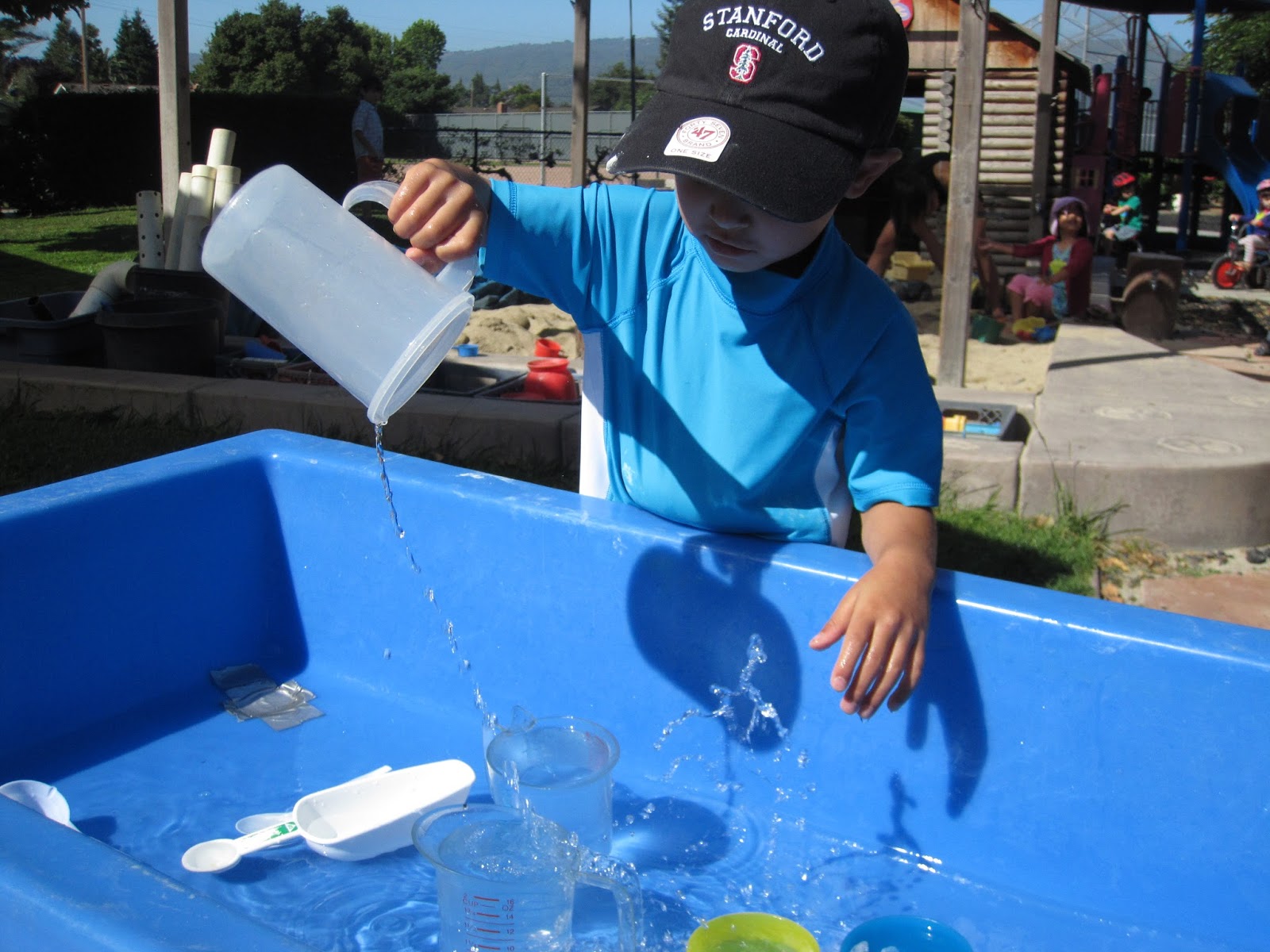
My sons loved to splash in the bathtub and wading pool when they were young but I see now I missed an opportunity to take their play to a deeper level of exploration. When I began teaching preschool years later, I saw how playing with water provides the perfect opportunity for promoting scientific inquiry at school and at home.

When children play with water they naturally ask questions: What will happen if I pour water from this container into this one? What if the container is already full of water? When they have lots of time to try pouring again and again with a variety of containers, children can begin to develop their own theories and understanding.

Water exploration is especially fun in summer when you don’t have to worry children will get cold if they get wet. During our preschool summer program we have several water tables and tubs set up every day because they are so popular. It’s easy to encourage water exploration at home, too, in the kitchen sink and bathtub, playing outdoors with a garden hose and in a wading pool. Note: it is essential that children have adult supervision at all times when playing with water.

Exploring Water with Young Children by Ingrid Chalufour and Karen Worth provides an in-depth look at water table science and provides detailed instructions for setting up and introducing materials over days and weeks so children can experience many different actions of water – flowing, dripping, spilling, splashing and bubbling.

At our preschool program we begin with different size containers in the water tables, including a variety of plastic measuring cups. On other days we add clear plastic tubing and funnels to introduce the idea of carrying water like pipes do and use a metal fence to help support the tubing so children’s hands are free. We introduce items that squirt and make drops such as turkey basters, eye droppers and plastic squirt bottles. We later introduce bottles and cups with holes punched in them so children can observe streams of water.

You can help deepen children’s thinking by asking questions such as:
·  How do you think the baster works?
·  What happens when you pour the big container of water into the little measuring cup?
·  What do you notice about the bubbles in the tube?

After children have had much time for free explorations you can propose challenges:
·  How can you move the water from this tub to this one?
·  Can you make water go up a tube?
·  Can you stop the water flowing?

Asking children to describe and draw what they see happening with the water, helps focus their attention and builds language and literacy. Math is naturally part of water exploration as children compare volume of different containers.


I enjoy introducing children to water exploration by reading a few pages at a time of I Get Wet by Vicki Cobb. Water Dance by Thomas Locker is a poetic look at different forms of water.

How do you encourage children's explorations as they are splishing and splashing? 

Tuesday, June 18, 2013

Spotlight on Young Children: Exploring Science

Although I look forward each month to Young Children and SECA’s tri-annual Dimensions of Early Childhood, sometimes I like to get my science in one big serving. Several members of the NAEYC Early Childhood Science Interest Forum (ECSIF) contributed to the new Spotlight on Young Children: Exploring Science published by the National Association for the Education of Young Children. (Full disclosure, some of my photos are included and I helped a bit with the introduction.) Many of my favorite articles from recent issues of Young Children are included as an expanded version.
This volume, along with Worms, Shadows and Whirlpools by Karen Worth and Sharon Grollman, can be the foundation for deepening or expanding your science program. The views into classroom practices offer guidance in developing science inquiry in preK to grade 2 programs, with recommended resources for further learning.

Read the piece on science standards by Linda Froschauer, ECSIF member, author and longtime science educator who is the editor of the National Science Teachers Association journal, Science and Children, to find out how national science standards are based on research into how children learn. Individuals, program administrators or science team leaders can use the questions and follow-up activities to lead groups in exploring, discussing and reflecting on, the articles on teaching science inquiry. Whether you are comfortable teaching science or wish someone else would do it, whether you like life science or physics best, and even if you are not yet a teacher, Spotlight on Young Children: ExploringScience will be enjoyable, enlightening reading.
Peggy Ashbrook

Sunday, April 07, 2013

Proposals due April 15, 2013 for next year's National Science Teachers Association national conference in Boston


I just attended a local early childhood conference where presenter Sarah Glassco taught us to use our imaginations and movement to become water drops in clouds, growing larger and falling, flowing over the land into a stream, into a river and into an ocean. This portion of the water cycle is wonderful fun for young children--to think as they move to recreate the water movement they have seen in nature and in the water table. 
What activities, thoughts on teaching using science inquiry, curriculum or other part of science teaching, in preK and up, do you want to share with other science-interested early childhood teachers? I'm looking forward to learning from you!
The National Science Teachers Association is calling for proposals to present a session at the 2014 national conference, Leading a Science Revolution (click here).  Due date for the proposals is April 15! To submit a proposal, please visit Presenting at Conferences. Confirmations for accepted sessions will be mailed in October.
The conference will begin with concurrent sessions on Thursday, April 3, at 8:00 AM and end on Sunday, April 6, at 12 Noon.
Conference Program Strands
  • Science and Literacy: A Symbiotic Relationship Attention to literacy is often seen as taking time away from science. In fact, built right into the Common Core State Standards for English Language Arts & Literacy in History/Social Studies, Science, and Technical Subjects, literacy can and should be used to enhance the effective teaching of science. Well-designed and integrated science and literacy instruction creates a symbiosis that supports classroom practice and student achievement. The investigation of science concepts within the elementary classroom enhances the development of reading, writing, and communication skills. At the upper grades, strengthened literacy skills continue to empower all students to access the science content and communicate their understanding. This strand will address how literacy and science are in service to each other across the learning continuum.
​
  • Teaching Elementary Science with Confidence!  With limited time, resources, and opportunities to learn science, it is no wonder elementary teachers find teaching science within the school day to be challenging. There is a constant struggle to find the time for engaging students in active science experiences. We also know that simply doing a science activity does not produce a deep understanding of concepts. This strand provides opportunities for elementary teachers to enhance their content knowledge, locate resources, incorporate science and engineering practices from the highly anticipated Next Generation Science Standards, and explore classroom management strategies when teaching science.

  • Leading from the Classroom. Throughout their careers, teachers grow professionally and often see opportunities to improve science education. But does that mean leaving the classroom? Why can't a teacher be both a classroom teacher and leader? Effective science teachers often think that the only way to increase their impact on science education is to leave the classroom. In fact, there are a myriad of leadership roles that can be fulfilled as a teacher leader. This strand addresses the skills and opportunities for developing leadership capacity while continuing to serve as effective classroom teachers.
​
  • Engineering and Science: Technological Partners. Are you integrating science and engineering practices into your instruction? Are you looking for the latest cool tools to enrich your classroom? With the NRC Framework and the highly anticipated Next Generation Science Standards defining science and engineering as intertwined, teachers are expected to integrate both within the science curriculum. This strand explores the thoughtful, effective, and meaningful integration of technologies to increase STEM learning and understanding.
Future NSTA conferences are all over the country--check out the list.
Hope to see you there or at the NAEYC national conference in Washington DC this year, November 2013, when the Early Childhood Science Interest Forum will hold its annual meeting.

Saturday, February 23, 2013

Professional conferences, and a physical science and engineering activity

The conferences of state and local professional associations can deliver a lot of learning experiences and networking in a short period of time. It's a way to get exposed to new ideas and be able to discuss them.


The Virginia Association for Early Childhood Education (VAECE), the Virginia state NAEYC affiliate, gathered early childhood educators together for a three-day conference. I attended sessions and presented twice on "Ramps and pathways: An appropriate and fun science of motion and engineering activity for young children."

During this session, participants explored the motion of objects on ramps, beginning with just one ball and a short ramp piece, and later exploring the motion of objects of various sizes, weights, and shapes. Adults and children begin exploring with these materials by making a simple ramp--complex structures come after more experience! With additional materials, participants branched out and built complex paths. They talked about their observations and argued for design changes to satisfy their curiosity and accomplish their goals. And made plans to bring the materials to the children in their programs!


Here is a short list of links and resources for learning more about the “Ramps and Pathways” physical science and engineering exploration that was developed at the University of Northern Iowa’s Center for Early Education in Science, Technology, Engineering and Math (CEESTEM) in the Regents Center.
“Ramps and Pathways: Developmentally Appropriate, Intellectually Rigorous, and Fun Physical Science” by Betty Zan and Rosemary Geiken in NAEYC's journal, Young Children, January 2010. 
Problem Solving and Physics in Preschool by Julie Stoll, Ashley Ann Hamilton, Emilie Oxley, Angela Mitroff Eastmand, and Rachel Brent. 2012. Young Children 67 (2): 20-26.
Q&A with the authors of Ramps & Pathways book, Rheta DeVries and Christina Sales
Regents' Center for Early Developmental Education, focusing efforts on improving early childhood education (birth through 8 years) in Iowa and beyond. Recognizing that children construct knowledge, intelligence, personality, and morality through active engagement with physical and social environments, the Center supports educational efforts that emphasize children's interest, experimentation, and cooperation. Note that the children in the videos have been using the materials for sometime and have a lot of experience with building and re-designing.  
"Problem Solving and Physics in Preschool" by Julie Stoll, Ashley Ann Hamilton, Emilie Oxley, Angela Mitroff Eastmand, and Rachel Brent. 2012. Young Children 67 (2): 20-26
I posted a bit about this activity on National Science Teachers Association's The Early Years blog.


Thank you to all the VAECE volunteers who made the conference such a success!
Peggy Ashbrook

Wednesday, December 19, 2012

Resources for early childhood science teaching

The Science in PreK Champions discuss teaching strategies.
Sharing resources and viewpoints is one of the benefits to belonging to an NAEYC Interest Forum. If we can't be together at school, a workshop or conference, we can still share our expertise and the resources we learned from. The Early Childhood Science Interest Forum is beginning to post resources that help us in our science teaching. Take a look at the NAEYC ECSIF page for NAEYC members, and choose “Content type” “Documents” to see the first posted resource, “"Productive Questions: Tools for Supporting Constructivist Learning" by Mary Lee Martens. Science and Children, May 1999. Pgs 24-27, 53. (Members of NSTA can also view this resource in the Science and Children archives.)

What resources do you recommend?