Pages

Saturday, February 23, 2013

Professional conferences, and a physical science and engineering activity

The conferences of state and local professional associations can deliver a lot of learning experiences and networking in a short period of time. It's a way to get exposed to new ideas and be able to discuss them.


The Virginia Association for Early Childhood Education (VAECE), the Virginia state NAEYC affiliate, gathered early childhood educators together for a three-day conference. I attended sessions and presented twice on "Ramps and pathways: An appropriate and fun science of motion and engineering activity for young children."

During this session, participants explored the motion of objects on ramps, beginning with just one ball and a short ramp piece, and later exploring the motion of objects of various sizes, weights, and shapes. Adults and children begin exploring with these materials by making a simple ramp--complex structures come after more experience! With additional materials, participants branched out and built complex paths. They talked about their observations and argued for design changes to satisfy their curiosity and accomplish their goals. And made plans to bring the materials to the children in their programs!


Here is a short list of links and resources for learning more about the “Ramps and Pathways” physical science and engineering exploration that was developed at the University of Northern Iowa’s Center for Early Education in Science, Technology, Engineering and Math (CEESTEM) in the Regents Center.
Ramps and Pathways: Developmentally Appropriate, Intellectually Rigorous, and Fun Physical Science by Betty Zan and Rosemary Geiken in NAEYC's journal, Young Children, January 2010. 
Problem Solving and Physics in Preschool by Julie Stoll, Ashley Ann Hamilton, Emilie Oxley, Angela Mitroff Eastmand, and Rachel Brent. 2012. Young Children 67 (2): 20-26.
Q&A with the authors of Ramps & Pathways bookRheta DeVries and Christina Sales
Regents' Center for Early Developmental Education, focusing efforts on improving early childhood education (birth through 8 years) in Iowa and beyond. Recognizing that children construct knowledge, intelligence, personality, and morality through active engagement with physical and social environments, the Center supports educational efforts that emphasize children's interest, experimentation, and cooperation. Note that the children in the videos have been using the materials for sometime and have a lot of experience with building and re-designing.  
"Problem Solving and Physics in Preschool" by Julie Stoll, Ashley Ann Hamilton, Emilie Oxley, Angela Mitroff Eastmand, and Rachel Brent. 2012. Young Children 67 (2): 20-26
I posted a bit about this activity on National Science Teachers Association's The Early Years blog.


Thank you to all the VAECE volunteers who made the conference such a success!
Peggy Ashbrook

Wednesday, December 19, 2012

Resources for early childhood science teaching

The Science in PreK Champions discuss teaching strategies.
Sharing resources and viewpoints is one of the benefits to belonging to an NAEYC Interest Forum. If we can't be together at school, a workshop or conference, we can still share our expertise and the resources we learned from. The Early Childhood Science Interest Forum is beginning to post resources that help us in our science teaching. Take a look at the NAEYC ECSIF page for NAEYC members, and choose “Content type” “Documents” to see the first posted resource, “"Productive Questions: Tools for Supporting Constructivist Learning" by Mary Lee Martens. Science and Children, May 1999. Pgs 24-27, 53. (Members of NSTA can also view this resource in the Science and Children archives.)

What resources do you recommend?

Tuesday, October 02, 2012

Letter to ECSIF membership announcing new and improved NAEYC IF platform for communicating and conference information


October 2012

NAEYC Early Childhood Science Interest Forum update Fall 2012

Hello to all members of the NAEYC Early Childhood Science Interest Forum (ECSIF),

The NAEYC Early Childhood Science Interest Forum (ECSIF) continues to work toward these goals
·       Provide a forum for the exchange of effective strategies and quality materials for science teaching in early childhood.
·       Establish and maintain a collaborative relationship with other professional organizations with similar goals.
·       Build early childhood educators’ understanding of the nature of quality science teaching and learning.
·       Promote public understanding of the importance of inquiry-based science in early childhood settings, as well as an understanding of what is appropriate content and a picture of what young children are capable of doing and learning.
·       Support efforts to expand professional development opportunities for teachers and administrators.

Communication platforms
NAEYC has created a new platform for interest forums to share news, photos, event announcements, resources, and information among members. All members of NAEYC are invited to view the pages and contribute! We all have to make a fresh start on this new platform and join the interest forums of our choice again.

Now the ECSIF has multiple places online to exchange our views and information about teaching science in early childhood settings. Choose the place that suits your needs:

·       The NAEYC ECSIF page (NAEYC membership, sign in and join even if you have previously joined the ECSIF), http://member-forums.naeyc.org/
Connect with other NAEYC Members who share your passion within Early Childhood Education by visiting our enhanced online communities - just launched! The user-friendly platform includes many new features, such as a photo gallery, chat opportunities, discussion boards, and many easy ways to engage with fellow members. Check them out and get the most value out of your NAEYC membership. Thanks for being a part of the NAEYC family and be sure to join the conversation!
·       The ECSIF blog, http://ecsif.blogspot.com/
·       The ECSIF Pinterest page, http://pinterest.com/ecisf/

National Conference
The Early Childhood Science Interest Forum is open to all—please add your voice. Join us at our annual meeting at the NAEYC 2012 conference in Atlanta, Georgia, on Friday November 9, 2012 from 6 PM – 7:30 PM in the Juniper Room Omni Hotel at CNN Center. We’ll show a brief video clip to stimulate discussion and plan for the future. We will also have a table with literature at the Interest Forum Café at the conference and will be there at most lunch hours.

The following sessions will be presented by ECSIF members:

More Ramps and Pathways: An approach to teaching physical science and engineering in early childhood
Betty Zan
Sonia Yoshizawa
11/7/2012 12:30 PM - 3:30 PM Room B213 Georgia World Congress Center

Learning to think: The role of scientific inquiry
Ingrid Chalufour
Nancy Clark-Chiarelli
Cindy Hoisington
11/8/2012 8:00 AM - 9:30 AM Room B216 Georgia World Congress Center

Science inquiry and practices: Fun experiences with hands-on materials to awaken young scientists
Peggy Ashbrook
Linda Froschauer
11/8/2012 3:00 PM - 4:30 PM Room B208 Georgia World Congress Center

Early Childhood Science Interest Forum Meeting
In Conjunction Group Activities
11/9/2012 6:00 PM - 7:30 PM Juniper Room Omni Hotel at CNN Center

Finding the trees in the forest: Support toddlers' developing problem-solving skills
Jill Uhlenberg
Rosemary Geiken
11/10/2012 1:00 PM - 2:30 PM Room B208 Georgia World Congress Center

We hope you will contact us before the conference if you plan to be there, especially if you want to help out at the Interest Forum Café! Please share this message with people you think will be interested, and reply "Unsubscribe" if you wish to be removed from this group email.

Sincerely,
Peggy Ashbrook
Ingrid Chalufour
Betty Zan
Early Childhood Science Interest Forum facilitators 

Saturday, September 29, 2012

The Right Plants for Butterflies

Have you ever been surprised to find caterpillars munching away on your garden veggies, herbs, or flowers? Some people might get upset about it, but early childhood teachers and their students seem to get very excited. By planning ahead you can create an environment that "calls" these visitors to your garden. In the spring my children were watering their garden and found caterpillars on the mature Violas (Johnny Jump-Ups) that they had planted in late fall. I googled what types of butterfly use Violas as a host plant and found that it was the Variegated Fritillary. We were able to collect a few, observe the changes and eventually were able to release the young adult butterflies. This happened again this fall when someone called me and said that there were caterpillars eating down their mature snapdragons. Again, I went online and found that the Buckeye butterfly used these plants as hosts. After collecting some of the larvae and plants, I put up a butterfly habitat in the science center. The children only had to wait a few days to observe the larva changing into their chrysalis. After only two weeks, we were able to release the beautifully marked Buckeyes. It was a bonus to see the colorful circle shapes on their wings, which tied nicely into finding shapes in our environment. Other plants to consider are: dill and fennel for Swallowtails, milkweed for Monarchs, and passion vine for Gulf Fritillaries. You can see a time lapse video of the variegated caterpillar eating if you go to http://prekladybugs.posterous.com/finding-caterpillars-in-the-garden
Buckeye Butterfly
1 day 16 hours ago
Variegated Fritillary Larva (J-Stage)
1 day 16 hours ago
Variegated Fritillary Chrysalis
1 day 16 hours ago
Variegated Fritillary Emerging
1 day 16 hours ago
Variegated Fritillary Release
1 day 16 hours ago

Tuesday, May 29, 2012

Call for early childhood educators to guide the direction of the Next Generation Science Standards

Peggy Ashbrook
Preschool science teacher
The Early Years columnist, Science & Children

We all have an opportunity to help shape the Next Generation Science Standards for K-12  by commenting on the first draft. The NGSS divides elementary school into K-2 and 3-5, making it easy to focus on early childhood. The last date to comment on this draft is June 2, just days away.  
You, as an early childhood educator, are in a very powerful position. Imagine who will be providing the majority of responses on the document ... they will come from higher education and high school teachers. Each of you have a voice that will be more significant because there will be fewer of us providing input. Speak up! Help the organization Achieve provide a document that is useful and supportive of our teaching practices.
1. Direct your energies in providing feedback to the areas of the standards most relevant to your work and your experience. The early childhood section is on pages 2-10 (pdf page 11).

2. Also, if you think this document represents a vision you share for science education, include that in your comments. Be sure to say what you like about NGSS! Consider that individuals and groups of all sorts will be providing feedback on this work, and that your comments matter.

I found it easier to have the “How to Read the Next Generation Science Standards” page open while I read through the standards. It also helped me to remember that the standards, called performance expectations, are made of three dimensions: Science and Engineering Practices, Disciplinary Core Ideas, and Crosscutting Concepts. These three dimensions are listed in the “Foundation Boxes” below each performance expectation. In my first read I did not read through them but it really helped me when I read them on my second time through the K-2 NGSS.

Click here to go to the Next Generation Science Standards website to see the May 2012 draft. Resources are also available on the NSTA Learning Center website (free registration for all).
Some helpful links:
·         The NGSS Matrix of Standards by Discipline and Grade Level (also available as a separate single-page document at the Learning Center).
·         The “How to Read the Next Generation Science Standards (NGSS)” document explains the layout.

I love the interconnectedness of the three dimensions, Science and Engineering Practices, Disciplinary Core Ideas, and Crosscutting Concepts, and the listing of the Common Core State Standards Connections.

One aspect of the NGSS that I am struggling with is the paring down of the Performance Expectations--only 3 subjects each in K, 1,  and 2. Will this lead to PreK-grade 2 teachers discarding useful branches of exploration such as examining bones or rolling objects on ramps? It may be that these 9 performance expectations are what children are expected to know by the end of 2nd grade, so they can be taught anytime in K-grade 2.

I am in favor of learning in depth about a few topics, using inquiry and practices, but I fear that teachers will discourage active inquiry about topics that are not in the NGSS at their grade level. Lilian Katz refers to "uncovering" children's understanding rather than covering all the topics, and I agree. But I don't want to discourage teachers from allowing their kindergarteners to pursue other concepts and topics, such as, rolling objects down ramps or observing the life cycle of a local insect.
Substructures, or parts of a whole, are not addressed until grade 3 but younger children use magnifiers and notice parts of a whole: veins in leaves, legs on insects, pupils in eyes, and bones of vertebrates (and a favorite topic in early childhood, bones in the fossil record).

Take a look, join the discussion on the NSTA Learning Center’s forums and when you are ready, give your feedback using the survey which will go to the state and other teams that will work on the next draft.
Early childhood prepares children for later science learning—what do you see addressed or left out of the Next Generation Science Standards?

Peggy

Wednesday, May 23, 2012

Raising Silkworms 
by Marie Faust Evitt
Mountain View Parent Nursery School
Mountain View, California.


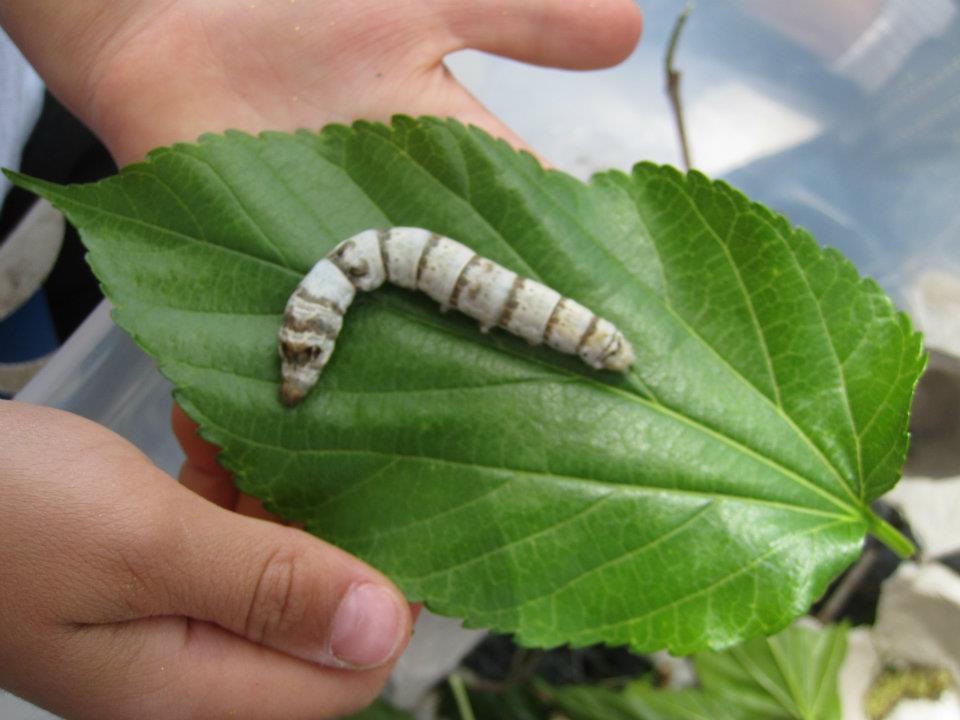
Silkworms provide an easy way for children to see a complete life cycle in about 10 weeks. The preschool where I teach raises silkworms every spring. 


We hatch silkworms from eggs our silk moths had laid the previous year. It takes about two to three weeks for the eggs to hatch after we take them out of the refrigerator where we had stored them.


The silkworms look like tiny black threads when they hatch. The silkworms grow fast on a diet of mulberry leaves. Fortunately we have a mulberry tree in our school yard.


After a couple weeks, the silkworms are big and hardy enough for the children to handle gently.


About a month after hatching the silkworms are ready to spin cocoons.


After three weeks in their cocoons, the silk moth emerge. They can't fly and they don't eat or drink. They live for about three to five days during which time they mate.


They mate for about a day.
The female then lays eggs and the male looks for another mate. We let the eggs sit for a few days then put them in a sealed plastic bag in the refrigerator and save them until the following spring.


Check this site for details about raising silkworms and links for buying eggs and artificial food.

Tuesday, May 15, 2012

Effective Teaching and Science Inquiry
by Ingrid Chalufour
Education Development Center, Inc.


How much science do early childhood teachers need to know? 


How can teachers build their science knowledge?


These pictures show teachers building their understanding of how to use forces, such as air and water pressure, to move water. At Education Development Center (EDC) Inc., we believe some science knowledge is essential for effective teaching. It is the only way teachers can set learning goals and create experiences that lead to science learning. We have been modeling the inquiry-based approach we want teachers to use with children as we teach science. Teachers are building their understanding from experiences, which is how most of us learn, while they learn the power of scientific inquiry.

Please share your ideas and experiences with us.